

ORY® product lines:
☑ Skincare (low-level; body, oily-skin, and oil-cleansing uses)
☑ Haircare (hero scalp oil)
☑ Handmade Soap
◐ Cosmetics (limited: low-level fragrance and brow serums) — dual-use ingredient (see also the Rosemary infusion and Rosemary Extract documents)
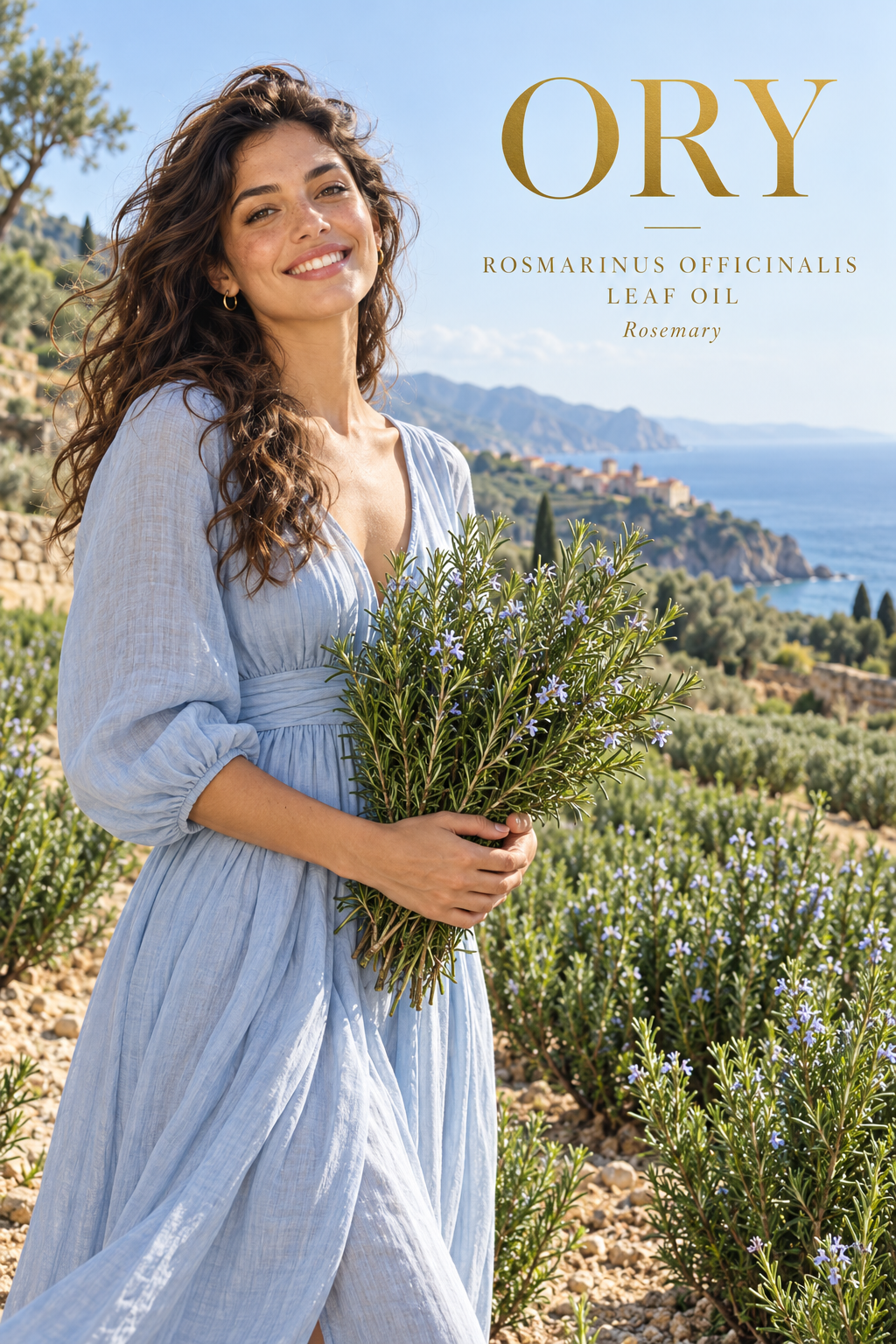
Rosmarinus officinalis leaf oil is the steam-distilled essential oil of rosemary (Salvia rosmarinus) and the most evidence-backed essential oil for the scalp: in a six-month randomized trial, rosemary oil was comparable to 2% minoxidil for androgenetic hair loss, with less scalp itching [1], and rosemary leaf extract counteracted androgen-driven follicle suppression in an animal model [2]. Its aromatic terpenes — 1,8-cineole, camphor, and α-pinene — are antimicrobial and stimulate microcirculation, and the oil carries traces of the antioxidant diterpenes carnosic acid and carnosol [3]. It is a classic soap oil (strong, lasting herbal scent) and a purifying note for oily skin, but its camphor content sets dermal and pregnancy cautions, so ORY® uses it diluted (typically 1–2% in scalp products) and offers the gentler rosemary infusion or extract for sensitive customers. This document covers the essential oil; the dried leaf infusion and the standardized extract are covered separately.
What is Rosmarinus Officinalis Leaf Oil made of?
Rosemary oil is steam-distilled from flowering tops and leaves (yield ~1–2%); composition varies by chemotype and origin (Tunisia/Morocco cineole-rich; Spain camphor-rich; Corsica verbenone) [3, 4]:
- 1,8-Cineole (15–50%): Antimicrobial, circulation-stimulating, camphoraceous-fresh.
- Camphor (5–25%): Warming, circulation-stimulating; the constituent behind pregnancy and epilepsy cautions.
- α-Pinene (10–25%), β-pinene, camphene: Antimicrobial, uplifting; oxidize to sensitizers.
- Borneol, bornyl acetate, verbenone (chemotype-dependent): Supporting notes; verbenone type is favored for skincare.
- Carnosic acid and carnosol traces: Antioxidant diterpenes (far richer in the extract).
- Dermal maximum: ~6.5% (Tisserand, camphor-based for the camphor chemotype); typical scalp 1–2%, body 1–2%, face ≤0.5%, soap 2–4% [4].
What skin type is best suited for Rosmarinus Officinalis Leaf Oil?
Rosemary oil suits oily and dull skin; sensitive skin should use the extract or infusion instead:
- Oily: Astringent, antimicrobial; 0.5% in oil cleansers and toners.
- Acne-prone: Antibacterial; anti-inflammatory carnosic traces; 0.5% in blends.
- Combination: Purifying, at low levels.
- Normal: Invigorating body oils and washes.
- Mature: Circulation-stimulating body products; antioxidant support [3].
- Dry: Body only; avoid facial leave-on.
- Sensitive: Terpenes can tingle or irritate; use the rosemary infusion/extract instead; patch test.
What hair type is best suited for Rosmarinus Officinalis Leaf Oil?
Rosemary oil is ORY®‘s flagship scalp essential oil:
- Mature or thinning: Comparable to 2% minoxidil at 6 months in a randomized trial [1]; androgen-blocking follicle activity in animals [2]; claims stay cosmetic.
- Oily scalp: Astringent and antimicrobial; balances sebum.
- Dandruff-prone scalp: Antimicrobial and anti-inflammatory support.
- Dry or damaged: In hair oils with argan for shine (scalp focus).
- Straight, wavy, curly, coily: Scalp massage oil for all textures.
- Color-treated: Antioxidant support; avoid 48 hours after coloring.
- Sensitive scalp: ≤1%; less itching than minoxidil in the trial [1]; patch test.
What are the benefits of Rosmarinus Officinalis Leaf Oil?
Rosemary oil’s benefits are supported by randomized clinical, animal, and pharmacological studies [1–4]:
- Hair growth support: Comparable to 2% minoxidil for androgenetic alopecia [1]; follicle protection in animals [2].
- Scalp circulation: Cineole and camphor stimulate microcirculation; massage amplifies.
- Antimicrobial: Broad activity against bacteria and fungi, including scalp microbes [3].
- Antioxidant: Carnosic acid and carnosol traces [3].
- Anti-inflammatory: Reduces scalp and skin inflammation [3].
- Purifying for oily skin: Astringent, clarifying.
- Cognitive and mood aroma: Alertness-promoting scent (aromatherapy tradition).
- Soap performance: Strong, lasting scent; pairs with lavender, peppermint, lemon, cedarwood.
Dual use across ORY® product lines
Rosemary oil serves haircare, skincare, and soap fully, with a limited cosmetics role.
| ORY® line | Dual use? | How it is used | Typical level |
|---|---|---|---|
|
ORY® Skincare |
Yes |
Oil cleansers and toners for oily skin, body oils and washes, muscle rubs (with eucalyptus). |
0.5% face; 1–2% body |
|
ORY® Haircare |
Yes |
Scalp massage oils and serums (with castor, jojoba, peppermint), shampoos, conditioners, hair oils. |
1–2% leave-on; 0.5–1.5% rinse-off |
|
ORY® Handmade Soap |
Yes |
Rosemary bars (rosemary-mint, rosemary-lemon, rosemary-lavender); mild acceleration. |
2–4% of oil weight |
|
ORY® Cosmetics |
Limited |
Brow serums (with castor), low-level herbal fragrance in solid perfumes and balms; not lip or eye-area products. |
0.1–0.5% |
Pros and cons of Rosmarinus Officinalis Leaf Oil
Pros
Cons
- Randomized-trial hair evidence: Rare for an essential oil [1].
- Antimicrobial and circulatory: Scalp and oily-skin fit.
- Soap-friendly: Strong scent retention.
- Affordable, sustainable: Widely grown.
- Multi-form family: Oil, infusion, and extract for every tolerance.
- Camphor cautions: Avoid in pregnancy and epilepsy without guidance; not for young children [4].
- Irritation on sensitive/facial skin: Use the extract or infusion instead.
- Oxidation: Pinenes oxidize to sensitizers; keep fresh.
- Slow hair results: Six months in the trial; not a drug.
- Claims discipline: “Supports fuller-looking hair” only.
What is the best application of Rosmarinus Officinalis Leaf Oil?
Rosemary oil is diluted into scalp, body, and soap products:
- Scalp massage oil: 1–2% in jojoba or castor blend; massage 5 minutes, leave 30+ minutes, shampoo; 3–4× weekly for 6+ months [1].
- Leave-in scalp serum: 1% in a light carrier daily.
- Shampoo: 0.5–1%.
- Oil cleanser for oily skin: 0.5%.
- Body wash or muscle rub: 1–2% with eucalyptus.
- Soap: 2–4% of oils.
- Brow serum: 0.5% with castor and jojoba.
Peer-reviewed references
- Panahi Y, Taghizadeh M, Marzony ET, Sahebkar A. Rosemary oil vs minoxidil 2% for the treatment of androgenetic alopecia: a randomized comparative trial. Skinmed. 2015;13(1):15–21.
- Murata K, Noguchi K, Kondo M, et al. Promotion of hair growth by Rosmarinus officinalis leaf extract. Phytotherapy Research. 2013;27(2):212–217.
- Nieto G, Ros G, Castillo J. Antioxidant and antimicrobial properties of rosemary (Rosmarinus officinalis L.): a review. Medicines. 2018;5(3):98.
- Tisserand R, Young R. Essential Oil Safety: A Guide for Health Care Professionals. 2nd ed. Churchill Livingstone/Elsevier; 2014. (Dermal-limit reference.)
Disclaimer:
The information on this page is provided by ORY International, LC for educational purposes only. It summarizes published research about rosemary essential oil (Rosmarinus officinalis leaf oil) as an ingredient, including laboratory and animal studies and clinical studies of formulas that may differ from ORY® products. Results from these studies may not apply to every person or to ORY® products. This page is not medical advice and does not replace advice from a dermatologist, physician, or other qualified healthcare provider.
ORY® Skincare, Haircare, Handmade Soap, and Cosmetics products are cosmetics. They are not intended to diagnose, treat, cure, mitigate, or prevent any disease or condition, including hair loss (including androgenetic alopecia), dandruff, acne, infections, muscle pain, or any other condition. References to FDA or Cosmetic Ingredient Review (CIR) findings describe the ingredient, not ORY® products, and do not mean FDA has reviewed or approved any ORY® product.
Results vary by skin and scalp type, formulation, and use. Rosemary essential oil contains fragrance allergens such as limonene and linalool, which can cause allergic reactions, especially once oxidized, and can irritate sensitive skin. Any cosmetic can cause irritation, sometimes from other ingredients. Always patch test, follow label directions, and stop use if irritation occurs. If you are pregnant, nursing, have a medical condition, or are buying for a child, consult a healthcare provider before use.
ORY International, LC works to keep this page accurate and current but makes no warranty as to its completeness. To the fullest extent permitted by law, ORY International, LC is not liable for any loss or injury arising from reliance on this information or from use of any product contrary to its label directions. To report a reaction, contact us at [insert contact email / phone].