
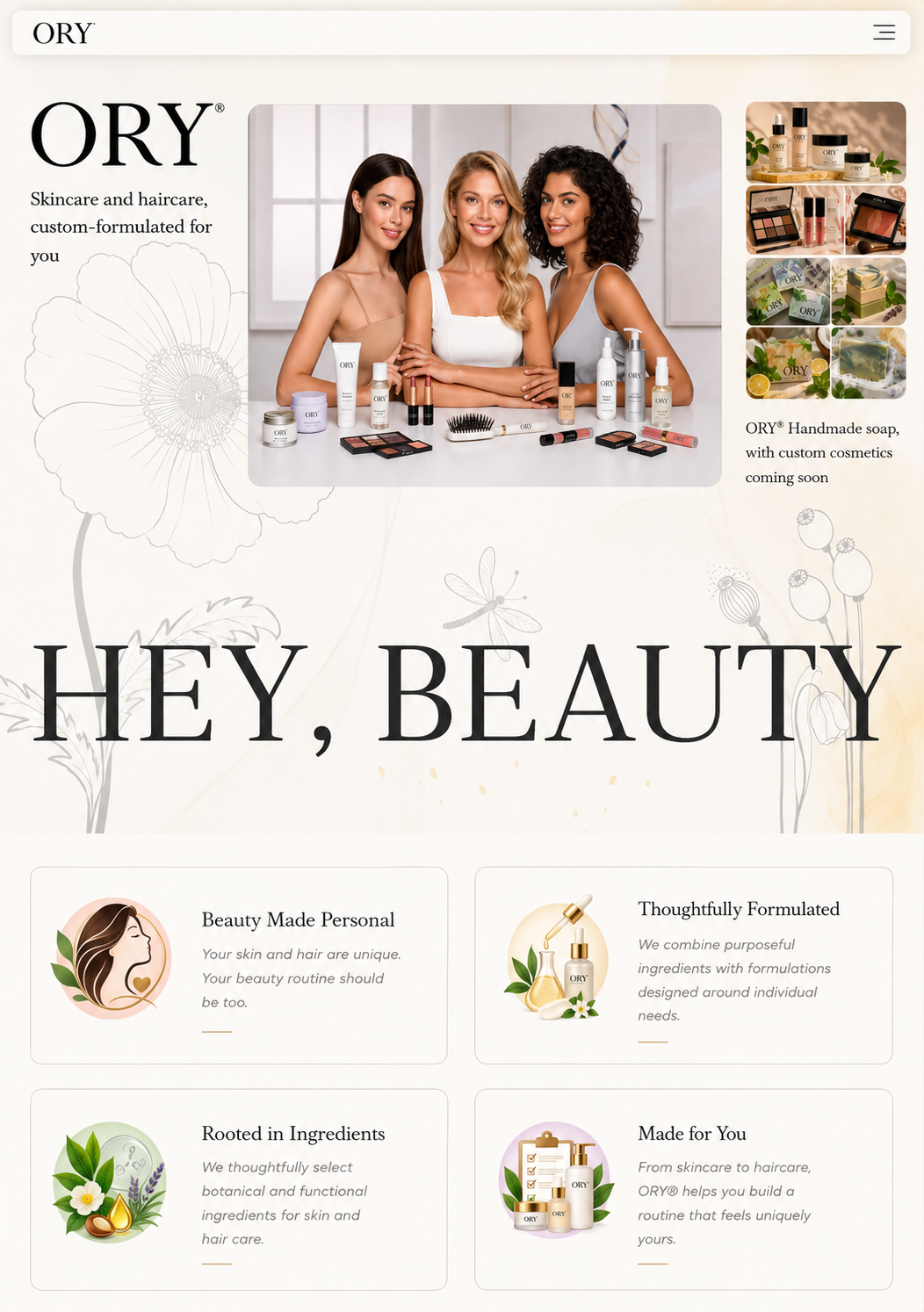
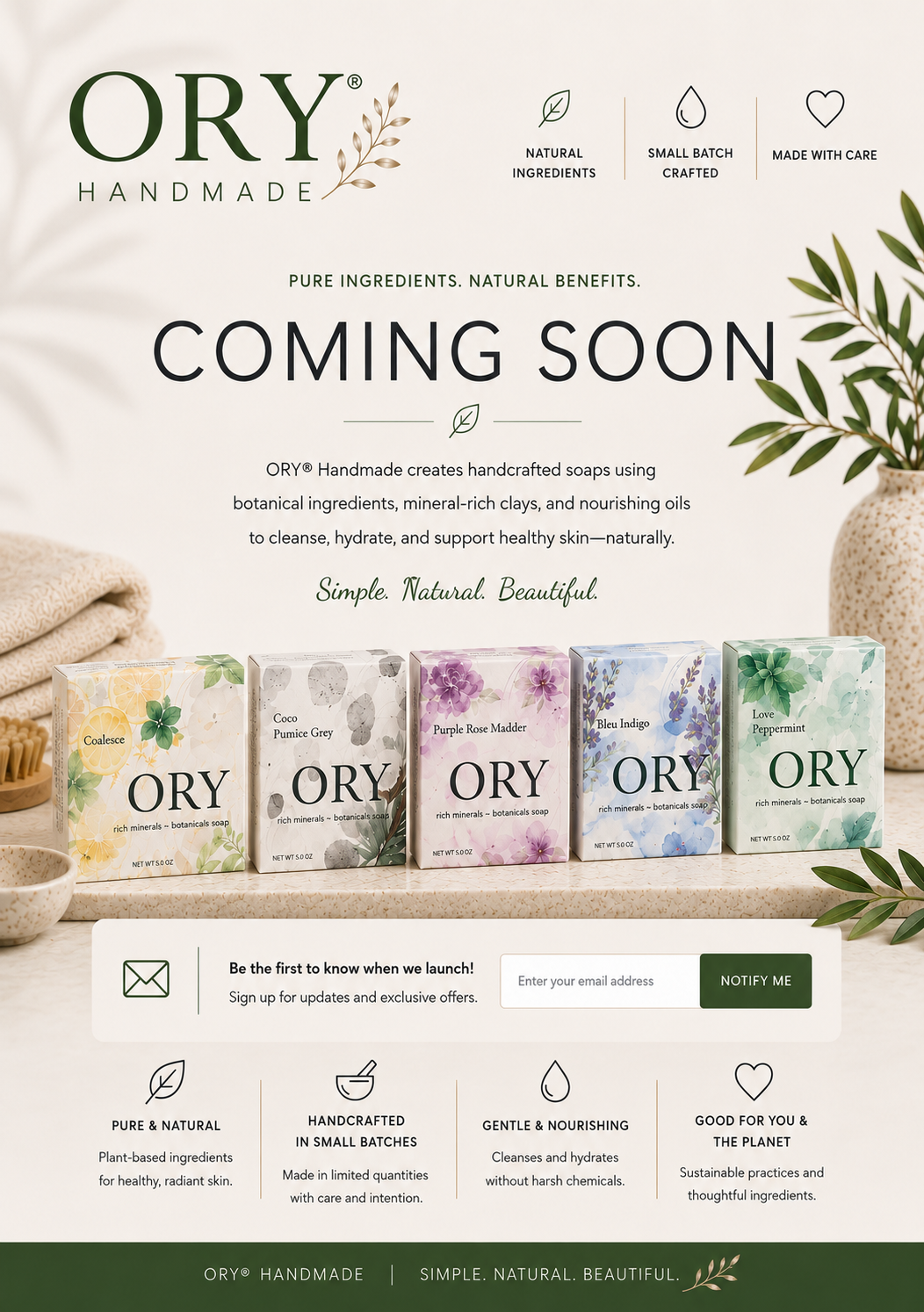
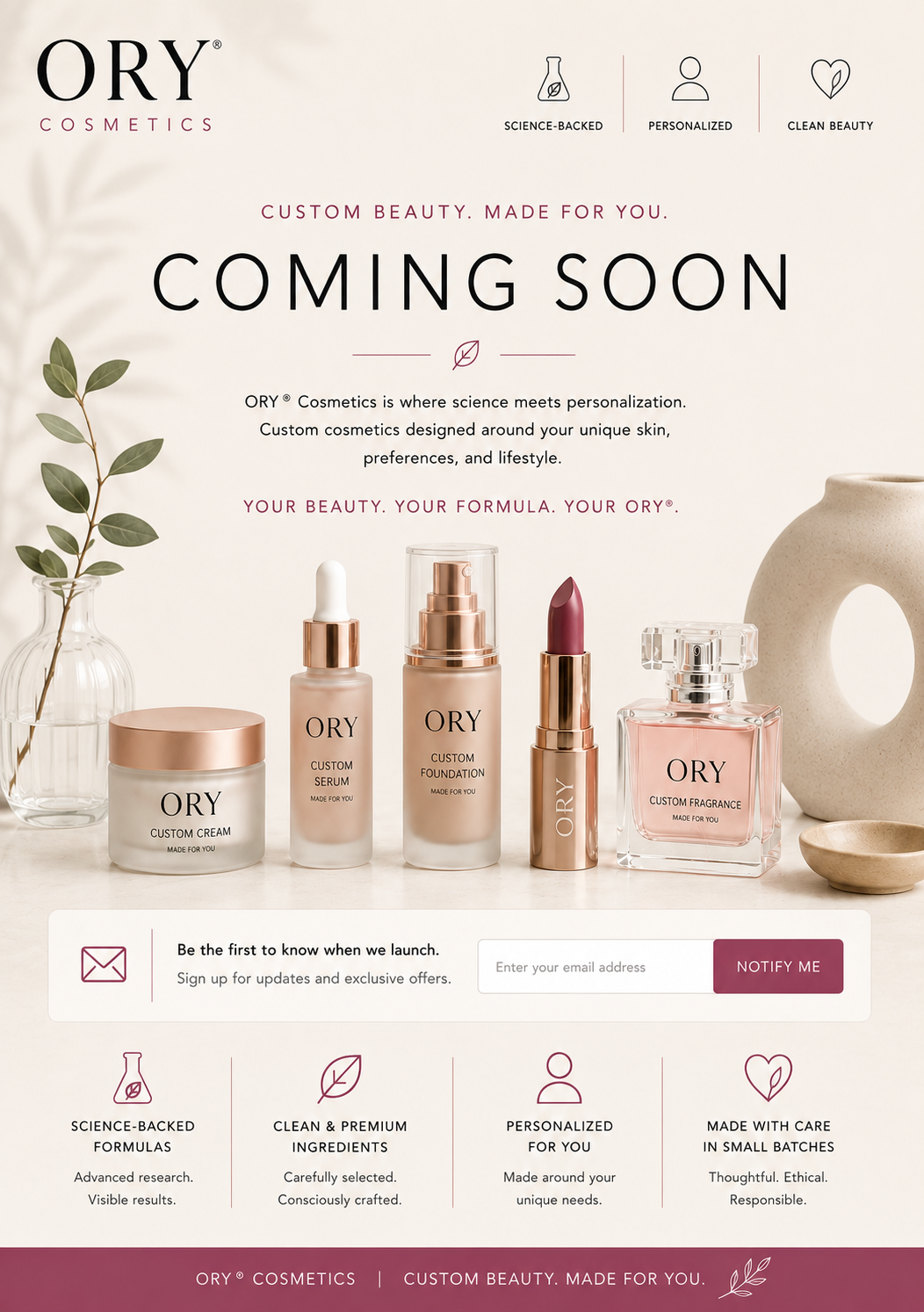

ORY® product lines:
☑ Skincare
☑ Haircare
◐ Handmade Soap (superfat)
☑ Cosmetics — four-line with soap limited to superfat (squalane does not saponify)
Green Tea + Rosemary + Chamomile Infused Squalane + Argan Oil is an ORY® Build-Your-Own infused oil: dried Green Tea, Rosemary and Chamomile steeped in a blend of Squalane and Argan Oil, then strained and protected with vitamin E and rosemary antioxidant. It blends squalane’s weightless, sebum-identical slip with argan’s vitamin-E nourishment to carry a scalp-and-skin trio: rosemary for hair support, green tea for antioxidant and sebum balance, chamomile to calm. Each botanical brings peer-reviewed support — Green Tea: green tea polyphenols reduced UV-induced sunburn and DNA damage in human skin, topical EGCG improved acne in a human trial, and EGCG prolonged the growth phase of cultured human hair follicles; Rosemary: rosemary oil was comparable to 2% minoxidil for androgenetic hair loss in a six-month randomized trial, rosemary leaf extract promoted hair growth in an animal model, and rosemary extract protected human skin from UV damage; Chamomile: reviews document anti-inflammatory, antimicrobial, and wound-healing activity, and a chamomile cream performed comparably to low-potency hydrocortisone in atopic eczema. A refined, lightweight scalp-and-face oil for oily, thinning, or sensitive scalps and blemish-prone skin. Because it is an anhydrous oil, it needs no preservative and can be used neat, blended into creams and balms, massaged into the scalp, folded into cosmetics, or added to handmade soap as a superfat or recipe oil, depending on the carrier.
What is Green Tea + Rosemary + Chamomile Infused Squalane + Argan Oil made of?
Green Tea + Rosemary + Chamomile Infused Squalane + Argan Oil is compounded from dried botanicals and cold-pressed or plant-derived carriers. Components and what each contributes:
Carrier selection: the carriers are blended so that Squalane gives weightless while Argan Oil gives light-to-medium.
- Green Tea (Camellia sinensis leaves): catechins (EGCG — mainly water-soluble, partly captured), caffeine, chlorophyll, vitamin E, and lipophilic aroma compounds. Evidence — green tea polyphenols reduced UV-induced sunburn and DNA damage in human skin, topical EGCG improved acne in a human trial, and EGCG prolonged the growth phase of cultured human hair follicles.
- Rosemary (Salvia rosmarinus (formerly Rosmarinus officinalis) leaves): carnosic acid and carnosol (oil-soluble diterpene antioxidants), rosmarinic acid (partly), ursolic acid, and aromatic terpenes (1,8-cineole, camphor, α-pinene). Evidence — rosemary oil was comparable to 2% minoxidil for androgenetic hair loss in a six-month randomized trial, rosemary leaf extract promoted hair growth in an animal model, and rosemary extract protected human skin from UV damage.
- Chamomile (Matricaria chamomilla (German chamomile) flowers): alpha-bisabolol, bisabolol oxides, matricin/chamazulene, apigenin (partly oil-soluble). Evidence — reviews document anti-inflammatory, antimicrobial, and wound-healing activity, and a chamomile cream performed comparably to low-potency hydrocortisone in atopic eczema.
- Squalane: weightless, sebum-identical, non-comedogenic, never rancid; best for every skin type including oily, acne-prone, and sensitive; hair — fine to medium hair and scalp serums (silicone-free slip); soap — does not saponify — superfat only (1–3%); shelf life 3+ years.
- Argan Oil: light-to-medium, nourishing, vitamin-E-rich; best for mature, dry, and normal skin (low comedogenicity); hair — the hero anti-frizz, shine hair oil for all textures; soap — conditioning at 5–10% of oils or superfat; shelf life 12–18 months.
- Vitamin E (0.5–1%) and rosemary oleoresin (0.1%): Antioxidant protection of the infusion.
What skin type is best suited for Green Tea + Rosemary + Chamomile Infused Squalane + Argan Oil?
Green Tea + Rosemary + Chamomile Infused Squalane + Argan Oil suits the following ORY® skin types (carrier choice fine-tunes the fit):
- Oily: Green tea supports sebum control; the carrier keeps it non-greasy.
- Acne-prone: Green tea EGCG (partial) plus calming botanicals; antioxidant carrier.
- Mature: Antioxidant, UV-stress defense, and repair support.
- Combination: Balanced facial oil.
- Normal: Daily antioxidant oil.
- Dry: Squalane-argan is light; layer under cream for dry skin.
- Sensitive: Calendula or chamomile calms; patch test (Asteraceae).
What hair type is best suited for Green Tea + Rosemary + Chamomile Infused Squalane + Argan Oil?
Green Tea + Rosemary + Chamomile Infused Squalane + Argan Oil is used on the scalp and hair as follows:
- Mature or thinning: Rosemary matched 2% minoxidil in a randomized trial; green tea EGCG supports follicle growth phase in vitro — cosmetic “fuller-looking hair” support.
- Oily scalp: Rosemary and green tea balance sebum; light carriers.
- Dandruff-prone scalp: Rosemary antimicrobial and anti-inflammatory support.
- Sensitive scalp: Calendula/chamomile/willow soften rosemary’s stimulation; patch test.
- Dry or damaged: Carrier conditions lengths and ends.
- Curly and coily: Scalp massage plus sealing.
- Straight, wavy, color-treated: Scalp-focused use; avoid 48 hours after coloring.
What are the benefits of Green Tea + Rosemary + Chamomile Infused Squalane + Argan Oil?
The blend’s benefits combine each botanical’s evidence with the carrier’s properties:
- Green Tea: Green tea polyphenols reduced UV-induced sunburn and DNA damage in human skin, topical EGCG improved acne in a human trial, and EGCG prolonged the growth phase of cultured human hair follicles.
- Rosemary: Rosemary oil was comparable to 2% minoxidil for androgenetic hair loss in a six-month randomized trial, rosemary leaf extract promoted hair growth in an animal model, and rosemary extract protected human skin from UV damage.
- Chamomile: Reviews document anti-inflammatory, antimicrobial, and wound-healing activity, and a chamomile cream performed comparably to low-potency hydrocortisone in atopic eczema.
- Squalane carrier: Weightless, sebum-identical, non-comedogenic, never rancid; suits every skin type including oily, acne-prone, and sensitive.
- Argan Oil carrier: Light-to-medium, nourishing, vitamin-E-rich; suits mature, dry, and normal skin (low comedogenicity).
- Antioxidant-protected: Vitamin E and rosemary oleoresin extend shelf life and protect the botanicals.
- Preservative-free: Anhydrous; no water, no preservative needed.
Dual use across ORY® product lines
Green Tea + Rosemary + Chamomile Infused Squalane + Argan Oil serves the ORY® lines as an infused oil; its soap role depends on the carrier’s saponification behavior.
| ORY® line | Dual use? | How it is used | Typical level |
|---|---|---|---|
|
ORY® Skincare |
Yes |
Lightweight antioxidant face oils for oily/blemish-prone skin, calming night oils, eye-area oils. |
5–100% |
|
ORY® Haircare |
Yes |
Leave-in scalp serums for thinning or oily scalps, silicone-free shine serums, scalp massage oils. |
10–100% |
|
ORY® Handmade Soap |
Limited |
Superfat at trace only (squalane does not saponify; CCT/jojoba give soft bars); infused botanicals add label value. |
1–5% superfat |
|
ORY® Cosmetics |
Yes |
Brow and lash serums, lip oils, foundation slip (silicone-free). |
5–30% |
Pros and cons of Green Tea + Rosemary + Chamomile Infused Squalane + Argan Oil
Pros
Cons
- Evidence-backed botanicals: Green Tea, Rosemary and Chamomile each carry peer-reviewed support.
- Customer-matched carrier: Blended carriers balance feel and nourishment.
- Preservative-free and multi-use: Neat, in creams, on the scalp, in cosmetics, in soap.
- Natural positioning: Whole-botanical infusion in plant carriers.
- Stable: Antioxidant-protected; shelf life 12–18 months (shortest carrier).
- Infusion captures oil-soluble actives only: Water-soluble compounds (green tea catechins, willow salicin) are only partly transferred — pair with extracts for full activity.
- Potency varies: Botanical quality, ratio, and steeping time affect strength; ORY® standardizes its method.
- Allergy cautions: oil infusion captures only part of the water-soluble catechins — ORY® adds tea polyphenol palmitate or green tea extract where full EGCG activity is wanted; camphor-containing — the infusion is far milder than the essential oil; avoid heavy use in pregnancy or epilepsy without guidance; daisy-family (Asteraceae) allergy — patch test.
- Carrier limits: Squalane: does not saponify — superfat only (1–3%); Argan Oil: conditioning at 5–10% of oils or superfat.
- Claims discipline: Hair and healing benefits are cosmetic (“supports,” “helps calm”) — not drug claims.
What is the best application of Green Tea + Rosemary + Chamomile Infused Squalane + Argan Oil?
Green Tea + Rosemary + Chamomile Infused Squalane + Argan Oil is applied as a leave-on oil and built into products:
- Scalp massage treatment: Apply the squalane-argan infusion to the scalp, massage 5 minutes, leave 30–60 minutes (or overnight), shampoo; 3–4× weekly for 6+ months for thinning-hair support.
- Leave-in scalp serum: 3–6 drops daily on thinning or oily areas.
- Hair oil: 1–3 drops on ends for shine and protection.
- Pre-shampoo treatment: 20 minutes before washing for flaky or oily scalps.
- Facial oil: 2–3 drops for oily/blemish-prone skin (antioxidant, balancing).
- Cosmetics: Brow serum; lip or hair-shine cosmetics.
- Soap: Per the carrier’s soap role in the dual-use table.
Peer-reviewed references
- Elmets CA, Singh D, Tubesing K, Matsui M, Katiyar S, Mukhtar H. Cutaneous photoprotection from ultraviolet injury by green tea polyphenols. Journal of the American Academy of Dermatology. 2001;44(3):425–432.
- Kwon OS, Han JH, Yoo HG, et al. Human hair growth enhancement in vitro by green tea epigallocatechin-3-gallate (EGCG). Phytomedicine. 2007;14(7–8):551–555.
- Panahi Y, Taghizadeh M, Marzony ET, Sahebkar A. Rosemary oil vs minoxidil 2% for the treatment of androgenetic alopecia: a randomized comparative trial. Skinmed. 2015;13(1):15–21.
- Murata K, Noguchi K, Kondo M, et al. Promotion of hair growth by Rosmarinus officinalis leaf extract. Phytotherapy Research. 2013;27(2):212–217.
- Nieto G, Ros G, Castillo J. Antioxidant and antimicrobial properties of rosemary (Rosmarinus officinalis L.): a review. Medicines. 2018;5(3):98.
- Srivastava JK, Shankar E, Gupta S. Chamomile: a herbal medicine of the past with a bright future. Molecular Medicine Reports. 2010;3(6):895–901.
- Patzelt-Wenczler R, Ponce-Pöschl E. Proof of efficacy of Kamillosan® cream in atopic eczema. European Journal of Medical Research. 2000;5(4):171–175.
- Huang ZR, Lin YK, Fang JY. Biological and pharmacological activities of squalene and related compounds: potential uses in cosmetic dermatology. Molecules. 2009;14(1):540–554.
- Boucetta KQ, Charrouf Z, Aguenaou H, Derouiche A, Bensouda Y. The effect of dietary and/or cosmetic argan oil on postmenopausal skin elasticity. Clinical Interventions in Aging. 2015;10:339–349.
Disclaimer:
The information on this page is provided by ORY International, LC for educational purposes only. It summarizes published research about Green Tea + Rosemary + Chamomile Infused Squalane + Argan Oil as an ingredient, including laboratory and animal studies and clinical studies of formulas that may differ from ORY® products. Results from these studies may not apply to every person or to ORY® products. This page is not medical advice and does not replace advice from a dermatologist, physician, or other qualified healthcare provider.
ORY® Skincare, Haircare, Handmade Soap, and Cosmetics products are cosmetics. They are not intended to diagnose, treat, cure, mitigate, or prevent any disease or condition, including eczema, dermatitis, wounds, radiation dermatitis, acne, sunburn, hair loss, dandruff, or any other condition. References to FDA or Cosmetic Ingredient Review (CIR) findings describe the ingredient, not ORY® products, and do not mean FDA has reviewed or approved any ORY® product.
Results vary by skin and scalp type, formulation, and use. Chamomile and calendula are in the daisy (Asteraceae) family, so people allergic to ragweed or related plants may react. Some carriers come from nuts or seeds. Any cosmetic can cause irritation, sometimes from other ingredients. Always patch test, follow label directions, and stop use if irritation occurs. If you are pregnant, nursing, have a medical condition, or are buying for a child, consult a healthcare provider before use.
ORY International, LC works to keep this page accurate and current but makes no warranty as to its completeness. To the fullest extent permitted by law, ORY International, LC is not liable for any loss or injury arising from reliance on this information or from use of any product contrary to its label directions. To report a reaction, contact us at [insert contact email / phone].