


ORY® product lines:
☑ Skincare (product photostabilizer; SPF claims require OTC compliance)
☑ Haircare (color and fragrance UV protection)
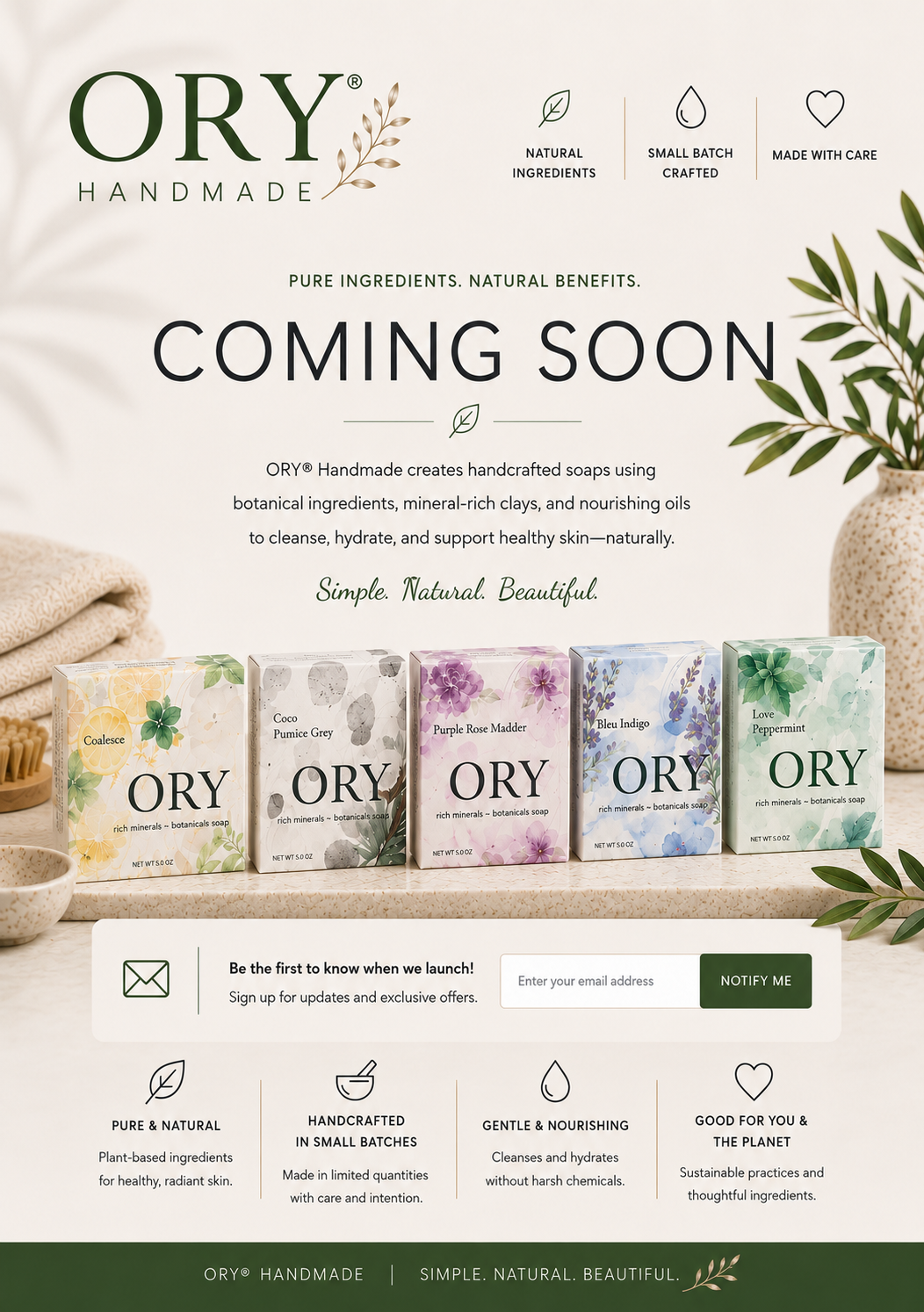
☑ Handmade Soap (prevents fading in clear and colored bars)
☑ Cosmetics — full dual-use ingredient with benzophenone-class scrutiny
Benzophenone-4 is a water-soluble UV filter that absorbs both UVB and short-wave UVA. In the United States it is an approved OTC sunscreen active at up to 10% [4], but its far more common role — and ORY®‘s primary use — is as a product photostabilizer: at 0.05–0.5% it absorbs the UV light that would otherwise fade colors, degrade fragrances, and oxidize botanicals in clear or translucent products, and it protects color-treated hair from UV fading. The Cosmetic Ingredient Review Panel has assessed the benzophenone family and concluded benzophenone-4 is safe as used [1]. Because it is a sulfonic acid, it is far less skin-permeable than its cousin oxybenzone (benzophenone-3), the compound behind the widely reported systemic-absorption and reef concerns [2, 3] — but the benzophenone class as a whole attracts scrutiny and can cause photoallergy in a minority, so ORY® discloses it clearly, keeps it at stabilizer levels, and does not make SPF claims without full OTC compliance.
What is Benzophenone-4 made of?
Benzophenone-4 is synthesized by sulfonating oxybenzone (benzophenone-3), which converts the oil-soluble filter into a water-soluble sulfonic acid. Points to know [1, 4]:
- Sulfonated benzophenone: Off-white powder; water-soluble (acidic; neutralize with sodium hydroxide or triethanolamine); absorbs 250–380 nm (UVB and UVA-II).
- Low skin permeability: The sulfonate group limits absorption compared with benzophenone-3 [1, 2].
- Regulatory: FDA OTC sunscreen active ≤10% (proposed rule requests more data for the class) [4]; EU annex allows ≤5% as a UV filter.
- Product-protection use (cosmetic): 0.05–0.5% to prevent UV fading of colors, fragrances, and botanicals — no sun-protection claims.
- pH-stable across 3–10; heat-stable; compatible with anionic and non-ionic systems (may interact with cationics at high levels).
What skin type is best suited for Benzophenone-4?
At photostabilizer levels benzophenone-4 is a formulation-level ingredient; as a sunscreen active it belongs to OTC products only:
- All skin types: At 0.05–0.5% it protects the product, not the skin, and is suitable for every ORY® skin type at that level.
- Sensitive: Benzophenones are recognized photoallergens in a minority; patch test; ORY® offers benzophenone-free alternatives (e.g., opaque packaging, ethylhexyl methoxycrylene).
- Oily and Combination: Water-soluble; does not add oil.
- Acne-prone: Non-comedogenic.
- Dry, Mature, Normal: Neutral at stabilizer levels; in OTC mineral-plus-chemical sunscreens it broadens UVA coverage.
What hair type is best suited for Benzophenone-4?
Benzophenone-4 is a classic color-protect ingredient in haircare:
- Color-treated: The core use — absorbs UV that fades dye and turns blonde brassy; used in color-protect shampoos, conditioners, and leave-in sprays.
- Straight, wavy, curly, coily: UV-protect leave-ins and sprays for sun exposure.
- Dry or damaged: Reduces UV-driven protein and lipid oxidation in the fiber.
- Oily scalp, sensitive scalp, dandruff-prone, mature or thinning: Neutral; product-level protection.
What are the benefits of Benzophenone-4?
Benzophenone-4’s benefits are functional, with a regulatory and safety context to state clearly [1–4]:
- Product photostabilization: Prevents UV fading of colors, fragrances, and botanical extracts in clear or translucent products.
- Hair color protection: Absorbs UV that fades dye and oxidizes hair proteins.
- Broad UV absorption: UVB and short UVA [1].
- Water solubility: Works in toners, gels, sprays, shampoos, and liquid soap where oil-soluble filters cannot.
- Low skin penetration: Sulfonated structure [1].
- pH and heat stability: Survives soap and hot processing.
- OTC sunscreen option: Approved active ≤10% for compliant SPF products [4].
Dual use across ORY® product lines
Benzophenone-4 serves all four ORY® lines as a low-level product photostabilizer; sunscreen use is reserved for OTC-compliant products.
| ORY® line | Dual use? | How it is used | Typical level |
|---|---|---|---|
|
ORY® Skincare |
Yes |
Photostabilizer in clear toners, gels, mists, serums, and botanical products (0.05–0.5%); UV filter only in OTC sunscreens. |
0.05–0.5% stabilizer; ≤10% OTC |
|
ORY® Haircare |
Yes |
Color-protect shampoos, conditioners, leave-in UV sprays. |
0.1–0.5% |
|
ORY® Handmade Soap |
Yes |
Prevents color and fragrance fading in clear melt-and-pour and colored cold-process bars; stable at soap pH. |
0.1–0.3% |
|
ORY® Cosmetics |
Yes |
Protects colors in setting sprays, gels, and clear products; UV filter in OTC tinted SPF. |
0.05–0.5% |
Pros and cons of Benzophenone-4
Pros
Cons
- Water-soluble UV protection: Unique among common filters.
- Protects products and hair color: Extends shelf life and appearance.
- Low absorption versus oxybenzone: [1, 2].
- pH- and heat-stable: Soap-compatible.
- CIR-reviewed: [1].
- Benzophenone-class scrutiny: Oxybenzone’s absorption and reef concerns color perception of the whole family [2, 3]; disclosure needed.
- Photoallergy: Documented in a minority; patch test.
- No SPF claims without OTC compliance: Sunscreen labeling, testing, and cGMP required [4].
- Clean-beauty exclusion: Excluded from most natural standards; offer alternatives.
- Acidic raw material: Requires neutralization; may interact with cationics.
What is the best application of Benzophenone-4?
Benzophenone-4 is added to the water phase as a stabilizer:
- Clear toner, gel, or mist: 0.1–0.2% to prevent fading of botanical color.
- Color-protect shampoo/conditioner: 0.2–0.5%.
- Hair UV spray: 0.3–0.5% leave-in.
- Melt-and-pour or colored soap: 0.1–0.3% dissolved in the water/glycerin phase.
- Setting spray or clear cosmetic: 0.1–0.3%.
- OTC sunscreen: Only under FDA sunscreen monograph compliance.
Peer-reviewed references
- Elder RL (ed). Final report on the safety assessment of benzophenones-1, -3, -4, -5, -9, and -11. Journal of the American College of Toxicology. 1983;2(5):35–77.
- Matta MK, Zusterzeel R, Pilli NR, et al. Effect of sunscreen application under maximal use conditions on plasma concentration of sunscreen active ingredients: a randomized clinical trial. JAMA. 2019;321(21):2082–2091.
- Wang SQ, Burnett ME, Lim HW. Safety of oxybenzone: putting numbers into perspective. Archives of Dermatology. 2011;147(7):865–866.
- U.S. Food and Drug Administration. Sunscreen drug products for over-the-counter human use; proposed rule. Federal Register. 2019;84(38):6204–6275. (Regulatory source.)
Disclaimer:
The information on this page is provided by ORY International, LC for educational purposes only. It summarizes published research about benzophenone-4 (sulisobenzone) as an ingredient, including laboratory and animal studies and clinical studies of formulas that may differ from ORY® products. Results from these studies may not apply to every person or to ORY® products. This page is not medical advice and does not replace advice from a dermatologist, physician, or other qualified healthcare provider.
ORY® Skincare, Haircare, Handmade Soap, and Cosmetics products are cosmetics. They are not intended to diagnose, treat, cure, mitigate, or prevent any disease or condition, including sunburn, skin cancer, sun damage, or any other condition. References to FDA or Cosmetic Ingredient Review (CIR) findings describe the ingredient, not ORY® products, and do not mean FDA has reviewed or approved any ORY® product.
Unless a product carries a Drug Facts label with an SPF value, it is not a sunscreen. Use a separate broad-spectrum sunscreen for sun protection.
Results vary by skin and scalp type, formulation, and use. Benzophenone-4 is an uncommon but recognized cause of allergic contact dermatitis, and any cosmetic can cause irritation, sometimes from other ingredients. Always patch test, follow label directions, and stop use if irritation occurs. If you are pregnant, nursing, have a medical condition, or are buying for a child, consult a healthcare provider before use.
ORY International, LC works to keep this page accurate and current but makes no warranty as to its completeness. To the fullest extent permitted by law, ORY International, LC is not liable for any loss or injury arising from reliance on this information or from use of any product contrary to its label directions. To report a reaction, contact us at [insert contact email / phone].