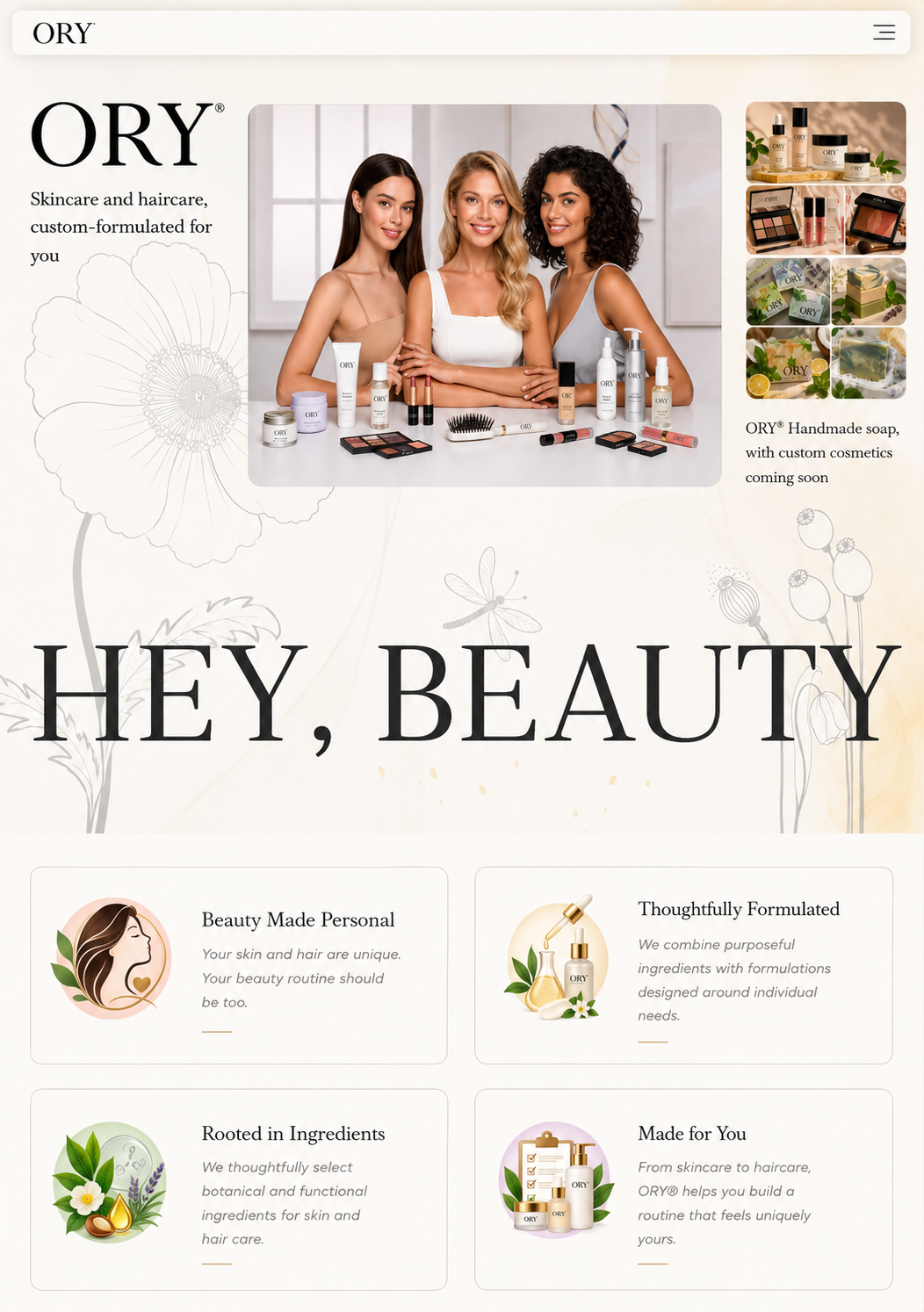


ORY® product lines:
☑ Skincare (cleansers and body washes for skin feel)
☑ Haircare (hero shampoo conditioning polymer)
◐ Handmade Soap (liquid soap, syndet, shampoo bars; not cold-process)
☑ Cosmetics (limited: cleansing products, mascaras) — dual-use functional ingredient
Guar hydroxypropyltrimonium chloride — “cationic guar” — is natural guar gum (from the seeds of the guar bean) modified with a positively charged quaternary ammonium group. That charge is the key to its performance: hair and skin carry a negative surface charge, especially when damaged, so cationic guar is attracted to them and deposits a thin conditioning film. In shampoos it does something more elegant. During rinsing, as the anionic surfactant is diluted, the cationic polymer and surfactant form an insoluble complex (a “coacervate”) that precipitates onto the hair, carrying conditioning agents and silicone alternatives with it — the mechanism by which conditioning shampoos condition [1, 2]. Cationic guar is the natural-origin star of this class, giving wet-comb slip, detangling, reduced friction, and softness in shampoos, co-washes, body washes, and shampoo bars, and it is the polymer of choice for natural and sulfate-free formulas. It is plant-derived, biodegradable, and, at use levels, non-irritating.
What is Guar Hydroxypropyltrimonium Chloride made of?
Cationic guar is made by reacting purified guar gum (a galactomannan) with a quaternary epoxide (glycidyltrimethylammonium chloride), attaching cationic hydroxypropyltrimonium groups. Points to know [1–3]:
- Galactomannan backbone: Natural polysaccharide from Cyamopsis tetragonoloba; biodegradable.
- Cationic charge (charge density 0.1–1.0 meq/g by grade): Higher charge = more deposition/conditioning; lower charge = lighter feel, less buildup.
- Coacervation: Forms polymer–surfactant complexes on dilution that deposit on hair and carry oils/silicone alternatives [1, 2].
- Physical form: Off-white powder; disperse in water at pH ~10 (or in glycol), then acidify to pH 5–7 to hydrate and thicken; some grades are “dispersible” at neutral pH.
- Typical use: 0.1–0.5% in shampoos and washes; 0.2–1% in conditioners; 0.5–2% in shampoo bars.
- Compatibility: Works with anionic and amphoteric surfactants (the point of coacervation) and with cationic conditioners; incompatible with strongly anionic polymers (carbomer).**
What skin type is best suited for Guar Hydroxypropyltrimonium Chloride?
Cationic guar is a formulation-level ingredient suitable for all seven ORY® skin types in rinse-off products:
- All skin types: Cationic guar is a formulation-level conditioning agent rather than a skin-type active; at use levels it suits every ORY® skin type.
- Sensitive: Reduces surfactant harshness in cleansers by forming a protective film; low irritation; patch test if polymer-sensitive.
- Dry: Leaves a soft, conditioned after-feel on skin after washing.
- Oily and Acne-prone: Non-comedogenic film; rinse-off use.
- Combination, Normal, Mature: Improves cleanser mildness and after-feel.
What hair type is best suited for Guar Hydroxypropyltrimonium Chloride?
Cationic guar is the natural conditioning polymer for every hair type; grade selection tunes the effect:
- Curly and coily: High-charge grades give slip and detangling in co-washes and sulfate-free shampoos.
- Dry or damaged: Deposits preferentially on damaged, negatively charged areas — repairs feel where it is needed [3].
- Color-treated or chemically processed: Reduces friction and breakage; smooths raised cuticles.
- Straight and wavy: Low-charge grades for light conditioning without buildup.
- Oily scalp: Conditions lengths from the shampoo without a heavy conditioner step.
- Sensitive scalp: Reduces surfactant harshness; mild.
- Dandruff-prone, mature or thinning: Light conditioning in treatment shampoos; low-charge grades avoid buildup.
What are the benefits of Guar Hydroxypropyltrimonium Chloride?
Cationic guar’s benefits are supported by hair-science literature [1–4]:
- Wet-comb detangling: Cationic deposition cuts combing force and breakage [1, 3].
- Coacervate delivery: Carries oils, butters, and silicone alternatives onto hair from a rinse-off shampoo [1, 2].
- Softness and slip: Smooth, conditioned feel on hair and skin.
- Reduced surfactant harshness: Protective film in cleansers and body washes.
- Anti-static and frizz control: Neutralizes negative charge on the fiber.
- Targeted repair feel: More deposition on damaged hair [3].
- Viscosity contribution: Mild thickening in surfactant systems.
- Natural origin: Plant-derived, biodegradable; suits sulfate-free and natural positioning.
Dual use across ORY® product lines
Cationic guar serves haircare as a hero, skincare and cosmetics in cleansing products, and the soap line in liquid, syndet, and bar shampoos — not in cold-process soap, where it reacts with soap anions.
| ORY® line | Dual use? | How it is used | Typical level |
|---|---|---|---|
|
ORY® Skincare |
Yes |
Body washes, facial cleansers, and shaving washes for conditioned after-feel and reduced harshness. |
0.1–0.3% |
|
ORY® Haircare |
Yes |
Conditioning and sulfate-free shampoos, co-washes, conditioners, detanglers, 2-in-1s. |
0.1–0.5% shampoo; 0.2–1% conditioner |
|
ORY® Handmade Soap |
Limited |
Liquid soap, syndet bars, and solid shampoo bars (0.5–2%); not cold-process bars (cationic–anionic incompatibility). |
0.2–2% |
|
ORY® Cosmetics |
Yes |
Cleansing balms-to-foam, makeup-removing washes, mascaras and brow gels (conditioning film). |
0.1–0.5% |
Pros and cons of Guar Hydroxypropyltrimonium Chloride
Pros
Cons
- Natural-origin conditioning polymer: Plant-based, biodegradable.
- Coacervate mechanism: Conditions from a shampoo [1, 2].
- Grade-tunable: Light to intense conditioning.
- Reduces cleanser harshness: Skin and scalp comfort.
- Affordable: Efficient at low levels.
- Buildup on fine hair: High-charge grades; clarify periodically or choose low-charge grades.
- Dispersion technique: Must be dispersed at alkaline pH or in glycol, then acidified — lumps otherwise.
- Cold-process incompatibility: Cationic reacts with soap.
- Anionic-polymer incompatibility: Not with carbomer.
- Limited safety literature specific to the derivative: Long safe-use history; general polymer data.
What is the best application of Guar Hydroxypropyltrimonium Chloride?
Cationic guar is built into cleansing and conditioning bases:
- Sulfate-free conditioning shampoo: 0.3% high-charge grade; disperse in water at pH 10, acidify to 5.5, add surfactants.
- Co-wash: 0.5% with BTMS and CAPB.
- Conditioner or detangler: 0.3–0.5% with BTMS.
- Body wash: 0.2% for skin feel.
- Shampoo bar: 1–2% with SCI or glucosides.
- Cosmetics: 0.2% in a cleansing balm-to-foam or mascara.
Peer-reviewed references
- Hössel P, Dieing R, Nörenberg R, Pfau A, Sander R. Conditioning polymers in today’s shampoo formulations – efficacy, mechanism and test methods. International Journal of Cosmetic Science. 2000;22(1):1–10.
- Goddard ED. Polymer/surfactant interaction: interfacial aspects. Journal of Colloid and Interface Science. 2002;256(1):228–235.
- Robbins CR. Chemical and Physical Behavior of Human Hair. 5th ed. Springer; 2012. (Reference text on hair conditioning and polymer deposition.)
- Gavazzoni Dias MFR. Hair cosmetics: an overview. International Journal of Trichology. 2015;7(1):2–15.
Disclaimer:
The information on this page is provided by ORY International, LC for educational purposes only. It summarizes published research about guar hydroxypropyltrimonium chloride (cationic guar) as an ingredient, including laboratory and animal studies and clinical studies of formulas that may differ from ORY® products. Results from these studies may not apply to every person or to ORY® products. This page is not medical advice and does not replace advice from a dermatologist, physician, or other qualified healthcare provider.
ORY® Skincare, Haircare, Handmade Soap, and Cosmetics products are cosmetics. They are not intended to diagnose, treat, cure, mitigate, or prevent any disease or condition, including eczema, dermatitis, acne, dandruff, or any other condition. References to FDA or Cosmetic Ingredient Review (CIR) findings describe the ingredient, not ORY® products, and do not mean FDA has reviewed or approved any ORY® product.
Results vary by skin and scalp type, formulation, and use. This ingredient is rarely irritating at use levels. Any cosmetic can cause irritation, sometimes from other ingredients. Always patch test, follow label directions, and stop use if irritation occurs. If you are pregnant, nursing, have a medical condition, or are buying for a child, consult a healthcare provider before use.
ORY International, LC works to keep this page accurate and current but makes no warranty as to its completeness. To the fullest extent permitted by law, ORY International, LC is not liable for any loss or injury arising from reliance on this information or from use of any product contrary to its label directions. To report a reaction, contact us at [insert contact email / phone].